

Black Friday all November: 20% off treatments.
“Will this actually work?” It’s the first thing almost everyone asks us when they come in about a fungal nail. Usually they’ve already spent months on paints and creams from the chemist, and they’re a bit fed up with a thick, discoloured nail that just won’t clear.
So here’s the honest answer we give in clinic. Yes, laser treatment can work very well for fungal nails. But it works slowly, it works best as a full course, and what you do at home afterwards matters just as much as what we do in the treatment room.
If topical treatments haven’t helped, you’d rather avoid antifungal tablets, or you need something that fits around work, this is for you. We’ll cover how laser works, what the research says, how long results take, how it compares with other treatment options, and how to stop the infection coming back.
A fungal nail infection (the medical name is onychomycosis) is usually caused by a type of fungus called dermatophytes. It often gets in through tiny cracks in the nail, then lives under and inside the nail plate rather than on the surface. That’s the trouble with most creams. They sit on top of a thick, hard nail and struggle to reach the fungus underneath.
Toenails get it far more often than fingernails. Feet spend all day in shoes and socks, warm and a bit damp, which is exactly what toenail fungus likes. It often starts with white or yellow streaks. Leave it and the affected nail can thicken, turn yellow or brown, crumble at the edges, lift away from the skin or develop a foul odour. Some people end up with a nail so thick it hurts when they walk or wear shoes.
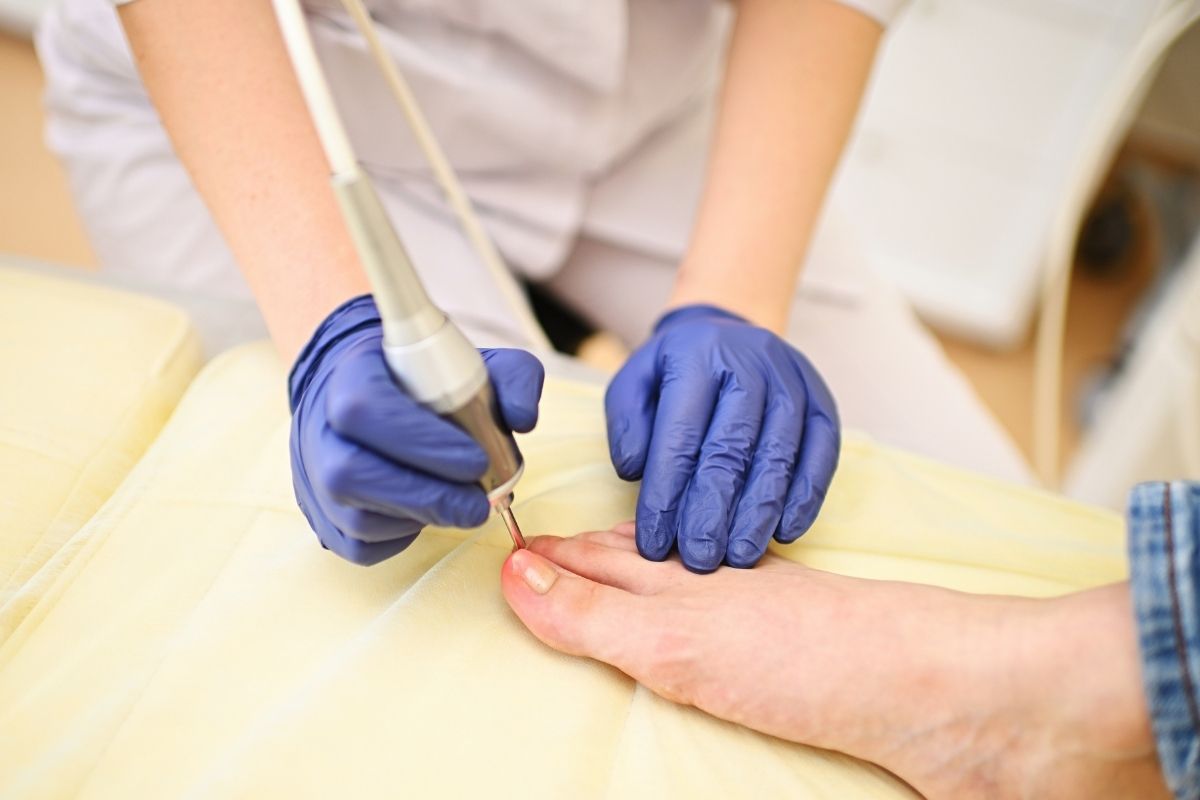
Laser therapy sends controlled light energy through the nail plate to the fungus in the nail bed underneath. The fungus absorbs that energy, heats up, and is damaged or destroyed, while the surrounding skin and tissue are left unharmed.
We use a medical-grade laser that combines Nd:YAG and Q-switched laser in one fungal nail treatment. A session takes 15 to 30 minutes, depending on how many nails we’re treating. It’s non-invasive and drug-free. You’ll feel warmth on the nail as we work, and we’ll check in with you as we go. Then you put your shoes back on and get back to your normal activities straight away.
It’s a fair question, and we’d rather you heard it straight. In 2019, researchers pulled together 35 studies covering more than 1,700 patients and over 4,000 infected nails. Across those studies, around 63% of nails treated with laser tested clear of fungus afterwards. The figure was the same for the 1064nm Nd:YAG laser, the type we use (Ma et al., Medicine, 2019).
Two things are worth knowing about that number. Clear of fungus doesn’t mean a perfect-looking nail straight away, because the old, damaged nail still has to grow out. And the studies varied a lot in size and quality, so treat it as a guide rather than a promise. Everyone’s nails are different.
This is what catches most people out. The laser deals with the infection, but it can’t repair the nail that’s already damaged. What you’re waiting for is healthy nail growth from the base, pushing the old, infected part out as it grows.
Nails grow slowly, so it tends to go like this:
We know that’s a long wait. Take a photo before your first session, so you can see the change as you go.
Most people need between 3 and 6 sessions, two to six weeks apart. One or two mildly affected nails might clear with three. A thick nail that’s been infected for years usually needs all six. We’ll look at your nails at your consultation and tell you honestly which we’d recommend.
Here’s how the main treatment options for fungal nails compare:
| Treatment | How it works | How long | Worth knowing |
|---|---|---|---|
| Creams and nail paints | You apply topical creams or paint to the nail surface | Daily or weekly for 6 to 12 months | Can struggle to get through a thick nail |
| Antifungal tablets | You take oral antifungals by mouth | Up to 6 months | Not suitable for everyone. They can have systemic side effects and drug interactions, so your GP will advise |
| Laser treatment | Light reaches the fungus under the nail | A short visit every few weeks | Several sessions, and there’s a cost |
If creams haven’t worked, or you’d rather not take tablets for months, laser is well worth considering. For some people, tablets from their GP are the better first step, and we’ll tell you if we think that’s true for you. In more stubborn cases, we may suggest using a topical treatment alongside your laser sessions. The NHS has a helpful overview of the usual treatments for fungal nail infections.
Most of our clients say no. It feels warm, sometimes quite hot for a second, and we can pause whenever you need. The skin around the nail might look a little pink for a few hours, occasionally a day or two, but it settles on its own. There’s no downtime, so you can go straight back to work.
Two practical tips for the day: take off any nail polish beforehand, and bring sandals or a clean pair of socks to change into.
The laser treats the nail, but fungus can hang around in your shoes, socks and bathroom, ready to have another go. To manage fungal nails effectively, aftercare matters. This is where you come in:
You’ll go home with a written aftercare plan, so you don’t need to remember all of this. Following it also helps protect your other nails from picking up the infection.
It could be a good fit if:
Some other nail conditions, including yeast infections and psoriasis, can look a lot like a fungal nail. We need to be sure what we’re treating before you start, which is why every course begins with a consultation. If you have diabetes or a weakened immune system, the NHS recommends speaking to your GP as well. The same goes if you have poor circulation in your feet.
A course of 3 sessions for up to 5 nails is £450. You’ll find all our prices on our fungal nail laser treatment in London page.
If a nail has been bothering you for a while, come in and talk to us about fungal nail laser treatment. We’re at 57 Wimpole Street, just around the corner from Harley Street. We’ll check your nails, answer your questions and only suggest treatment if we think it will help.
Want to know more about how our Aesthetics & Laser Clinic in London can help you? Send us a message with your concern and we will get back to you.
Please fill in the form and someone will call you to arrange your consultation.

